
Reflecting City Totems
Christine Nguyen’s two dreamlike seascapes for this bus station, titled Reflecting City Totems, invite transit users to connect with the ecology and terrain of Los Angeles County’s South Bay.
Christine Nguyen’s two dreamlike seascapes for this bus station, titled Reflecting City Totems, invite transit users to connect with the ecology and terrain of Los Angeles County’s South Bay.

Metro rail poster series commemorating the opening of the Metro Red Line, now B Line (Red), features the work of Constance Mallinson.
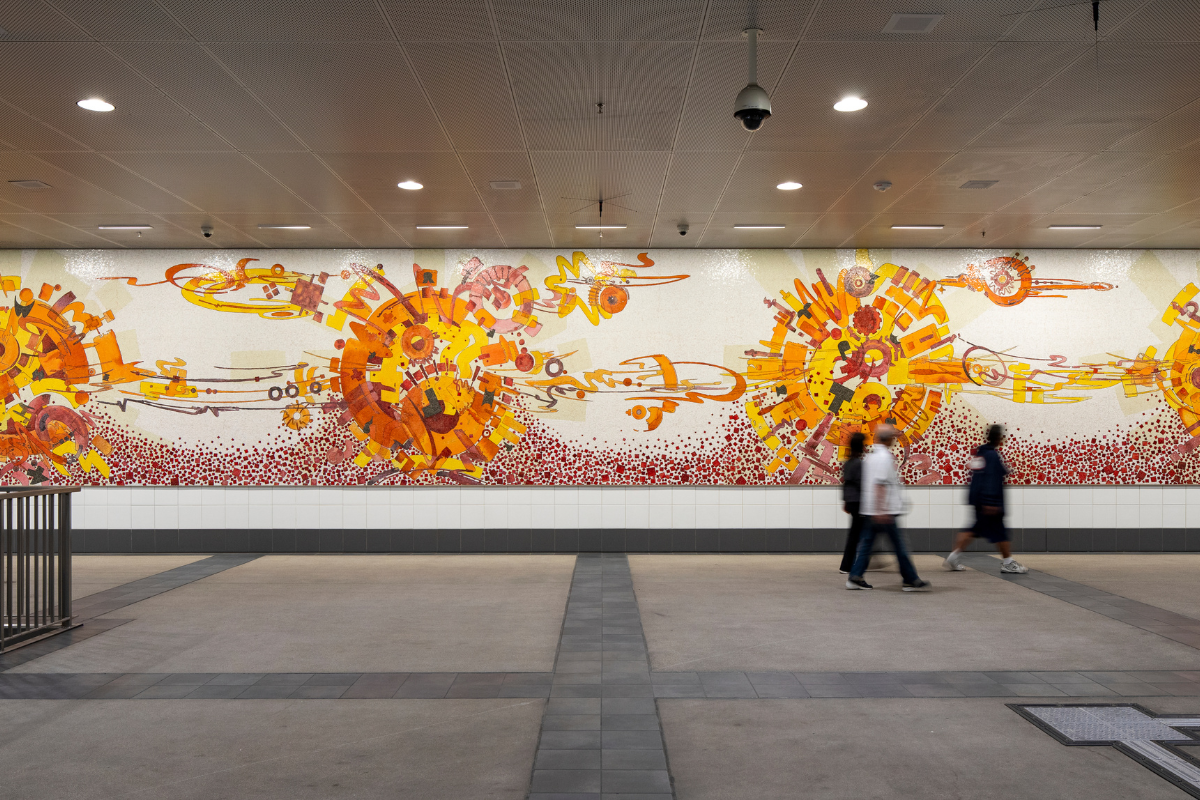
Mark Steven Greenfield’s glass mosaic, titled Red Car Requiem, for the station’s concourse will be a sentimental tribute to Los Angeles’s historic Pacific Electric Red Cars, a once iconic fixture in the city.

In “real green” at Vermont/Athens Station, artist Kim Yasuda and architectural collaborator Torgen Johnson sought not only to pay homage to, but to revive, the agricultural history of Gardena, a city once well-recognized for its gardens

Fran Siegel’s artwork for this underground station will consist of layered sequences from the surrounding landscape, above and below ground.

Artist John Outterbridge has created Pyramid, a bilateral, reinforced-concrete pyramidal form, located at the northwest end of the station entrance.

In Portrait Of My People #619, artist Willie Middlebrook has translated images of past and present artists from the surrounding community into a computer-generated porcelain enamel photo-mural.

Launched in October 1998 in partnership with the Poetry Society of America, Poetry in Motion/LA™ places poems directly in the path of more than one million Metro bus riders daily.

Playful Transportation shows mother and child playing with a toy train as an early introduction to transportation.

The artist team- Kipp Kobayashi, Noel Korten and Marta Perlas, AIA – created seating environments that produce a strong visual and functional experience for Metro riders at 7th/Metro Center Station, influenced by historic Batchelder tiles in the nearby Fine Arts Building.

Robin Brailsford’s Pioneros de la Rivera de San Gabriel (pioneers of the San Gabriel River, 2015) celebrates the pioneering spirit of the area’s five founding families and their descendants who capitalized on the unique local geology to create a thriving community and industrial center.

In train cars with ample space, passengers position themselves at carefully calibrated distances from their neighbors. However, once that space has been established they begin to relax and act as they might do in the privacy of home.

With unlimited access, the team hung out in the break rooms at bus divisions and talked to employees as they navigated the system.

‘Photo Binge’ satirizes an urban, commodity-driven culture that focuses on food, health, nutrition, beauty and the surface of things. The collage of images depicts various binge activities such as eating, exercising and shopping.

Phajah expresses the hope and optimism of South Los Angeles through a radiant portrait of a proud Black Leimert Park resident before a palm-lined skyline.
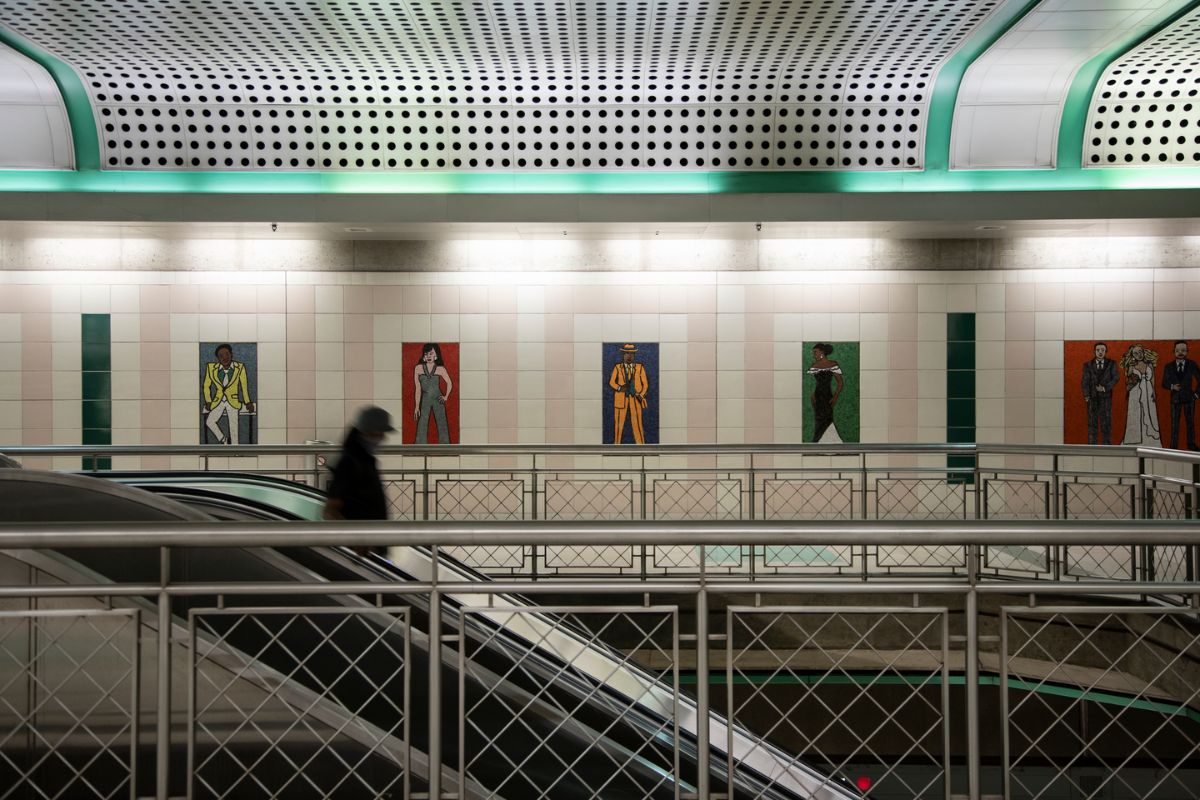
Faith Ringgold designed fifty-two individual smalti glass mosaics across four mezzanine walls. Each a personification of creativity, performance, sports and fashion illustrated in Ringgold’s signature style of line drawing a simplified figure in a solid, color-block background.

Tyree Guyton designed this artwork to evoke thought, create conversation and stimulate the observer to think about the most basic mode of transportation – the shoe.

Project Description Wyatt has designed two 52-feet long ceramic tile murals for the end walls of the Wilshire/Western Station. People Coming presents portraits of members of the community as they approach the viewer; People Going shows some members of that group walking away. Portions of the famous Wiltern Theater, located just across from the station entrance, can be seen in the back-ground. Painted in Wyatt’s realistic and dramatic style, the mural’s theme is at once the diversity of Los Angeles, its possible future, and a metaphor for a city always in transition. Artist Statement “I am interested in connecting with people through my art. In today’s corporate world the human element seems often to get lost—I try to bring back the human connection by monumentalizing people rather than buildings and objects. Hopefully, people will connect to the idea of how important they are to making the city, and mass transit, work. It was a challenge trying to translate the sensitivity of painting into tile. I spent over six months just experimenting with this new medium. Most of the finished …

Metro’s newly-opened Patsaouras Plaza Busway Station is on the south side of Patsaouras Plaza at Union Station and serves the Metro J Line (Silver) and other transit buses operating on the El Monte Busway Line. Commissioned artist Ned Kahn designed Wind Bridge, a new artwork that is a system of integrated metal panels along the pedestrian bridge leading to the new station.

At Willowbrook/Rosa Parks Station, artists Michael Massenburg and Robin Strayhorn created 5 seating areas out of concrete and ceramic tile, each seat honoring an important year in the life of Rosa Parks.

Each grouping of images within Union Station represent not only details from the physical environment, but also time and passage, light and vision, and the romantic notion of traveling and greetings over the years.

The artist’s use of a silk flower to mimic the imperfect appearance of a wilting lily—its blossoming, sagging, drying and falling petals—is a metaphor that investigates socially constructed notions of gender.

This artist team worked with project architects to form seating areas, planter walls and fountains which together form an inviting corner park.

Alison Saar’s Paraje is a reminder of the surrounding terrain’s natural history and is designed to offer transit users respite from the sun and wind. Located on the west end of the station platform and measuring 10 feet high by 10 feet wide, the cast stainless steel sculptural windscreen contains imagery inspired by the nearby Gardena Willows Wetlands Preserve, which is one of the few remaining pristine willow marshes in Los Angeles.

Union Station’s greenery is highlighted to create a temporarily refreshing moment and tranquil state of mind, recognizing that busy travelers may overlook the beauty of the station’s outdoor spaces and natural assets.