
Twelve Principles
With Twelve Principles, Joe Lewis seeks to emphasize shared values that exist in a world full of differences.
With Twelve Principles, Joe Lewis seeks to emphasize shared values that exist in a world full of differences.

Adjacent to the historic site of the Campo de Cahuenga where in 1847 Mexico relinquished control of California to the United States in the Treaty of Cahuenga, Tree of Califas draws its title from the the mythological black Amazon queen Califas who was said to have ruled a tribe of women warriors and after whom the Spaniards named California.

These photographs depict snow globes sculpted by the artists themselves. The winter wonderland vignettes traditionally associated with snow globes have been supplanted with weary commuters trundling with their baggage through blankets of bitter cold.
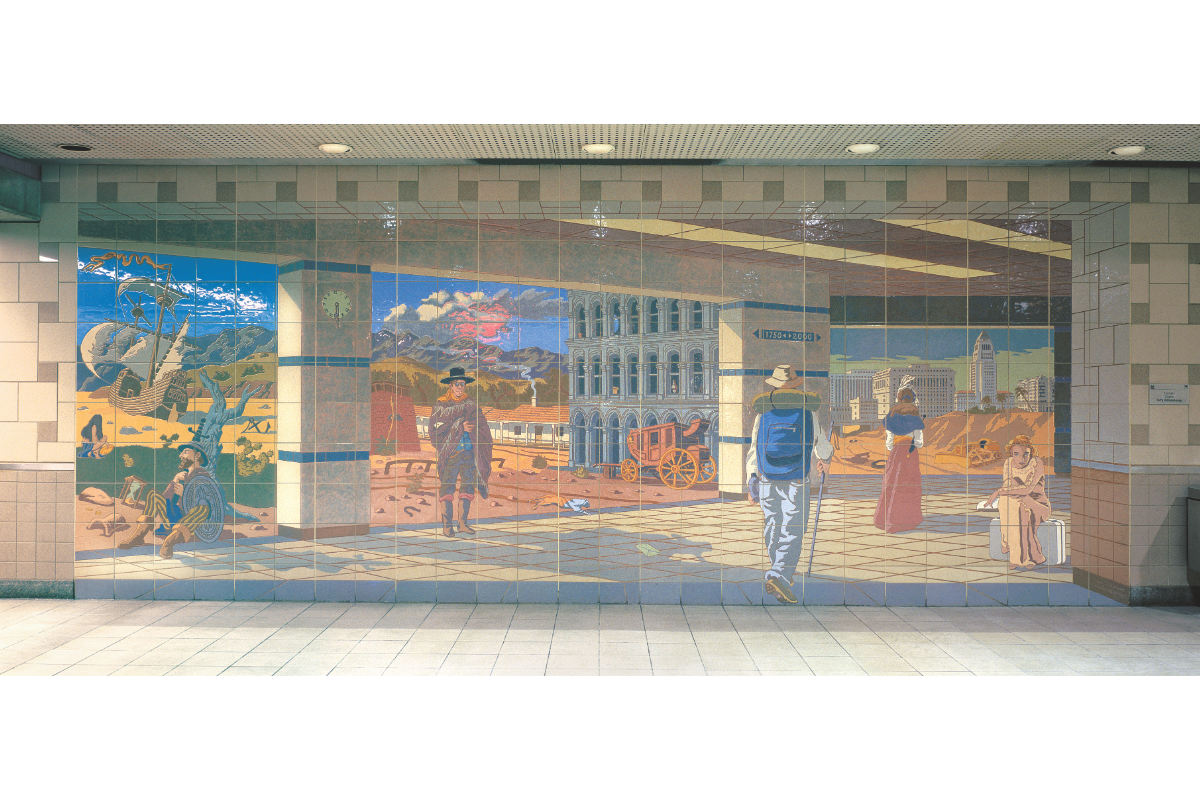
Traveler, a tile mural located at the bottom of the escalator at the east entrance of the subway station, depicts travelers from different eras in a Los Angeles “timescape” that features historical references such as Spanish galleons, the Pico House, Olvera Street and actress Carol Lombard.

Traveler honors the drifters, explorers, migrants, nomads and tourists.

At Sepulveda Station, Michele Martínez designed terrazzo paving areas with a pre-Columbian glyph and porcelain enamel steel maps for station platforms.

Nationally renowned artist Donald Lipski has created a clock tower for the entrance to the new El Monte Station.

Robin Brailsford’s Time and Presence at Pico Station examines the disparity between human scale and the vastness of the earth and the cosmos.

Playing with scale and our imagination, the metaphor of discovery and wonder is discovered here in the form of transportation, where the light rail becomes the “looking glass” into the undiscovered world.

Wheels of Change by Chusien Chang at the Chinatown Station is based on the ancient Chinese book of I Ching (translated as Book of Changes)

A series of four art panels depict momentary encounters of people crossing paths in their daily lives. The images visualize the movement, energy and unintentional patterns people create during their travels.

The Poet portrays Kamau, an instrumental figure in Leimert Park’s cultural renaissance.
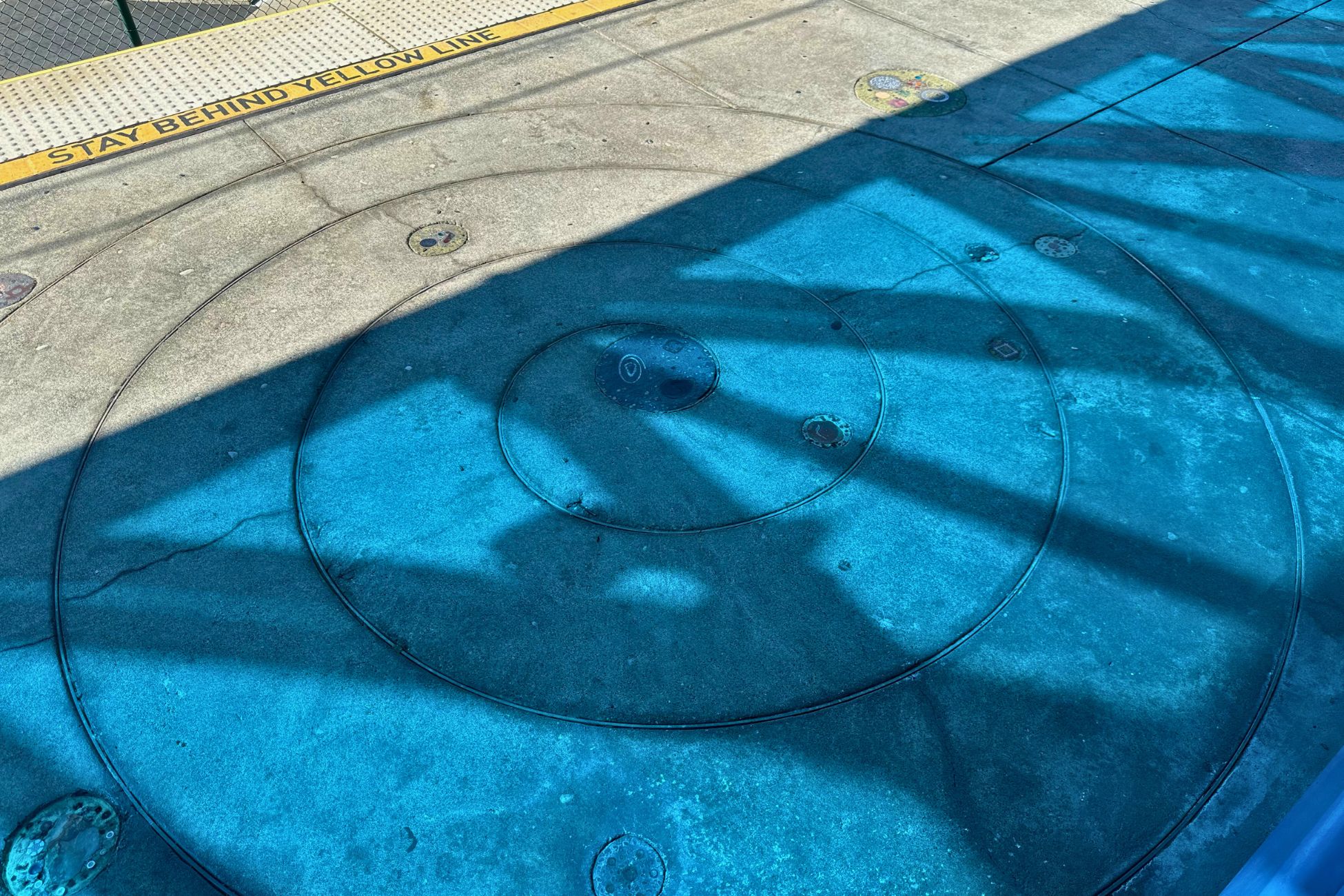
Carl Cheng’s project, The Museum of Space Information refers to two significant and very different aspects of the local area: the coastal strip and the aerospace industry. Travelers move from an imaginary sea bottom on the lower level (even the landscaping has been designed to have an underwater appearance) upward into space to the platform level.

This series of photographic portraits present the artists behind the artworks in the Metro system. The illuminated photographs on display in the Passageway Art Gallery depict the artists in their homes and studios, providing a glimpse into their distinct personalities and cultural influences.

Installed at eye level along the platform walls of 7th/Metro Center Station, Joyce Kozloff’s two long and narrow hand painted ceramic tile murals, The Movies: Fantasies, and The Movies: Spectacles, resemble an unfolding film strip.

The artist simultaneously recognizes Metro’s ridership and addresses an art historical gap, the vast underrepresentation of women of color.

Thinking metaphorically about the internal workings of the Metro system as a “well oiled machine,” the artist introduces shapes for train, bus and bicycle wheels and power gears all fluidly interconnected with a belt running throughout the floor design.

Project Description A sea of faces welcomes visitors to the station, a broad cultural mix of individuals who define life in the neighborhood. Dierdorff populated the station with intimate portraits of fronts and backs of heads as a commentary on public transportation, where people from many walks of life are removed from their personal spaces and find themselves in close physical proximity with strangers. The twelve individuals portrayed were photographed in locations that describe their role within the larger community. A variety of professions are represented, including a firefighter, a baker, a hat maker, and a mechanic, among others. Artist Statement “This sea of wondrous faces is Metro. Metro is not about people, Metro is people – thousands and thousands of different people every day. Each with their own story, their own worries, their own triumphs and their own tragedies – each different, each rare, each unique and each irreplaceable. The people who ride Metro every day are the same people from your favorite memory. They are your grandmother, your mother, your sister and your …

Photo based artworks by five artists address Union Station as The Heart of Los Angeles on the occasion of its seventy-fifth anniversary.

The Great R-38 depicts Joshua, a rail-loving toddler, awaiting the train under the expert guidance of his grandfather Thurman, a 30-year Metro veteran who retired his employee number “R-38.”

The familiar yet unidentifiable landscape of the “passing scene” allows the viewer to also inhabit the space of the traveler in the photographs, to be in these non-places without fixing on destination.

The artist chose four elements: family, faith, work, and history to represent the spirit of the East Los Angeles community.

The Memorial Park Station inspired John Valadez to honor the area’s earliest indigenous artists, whose ancient pictographs and carvings have been discovered in caves and on rock cliffs and natural outcroppings throughout Southern California.
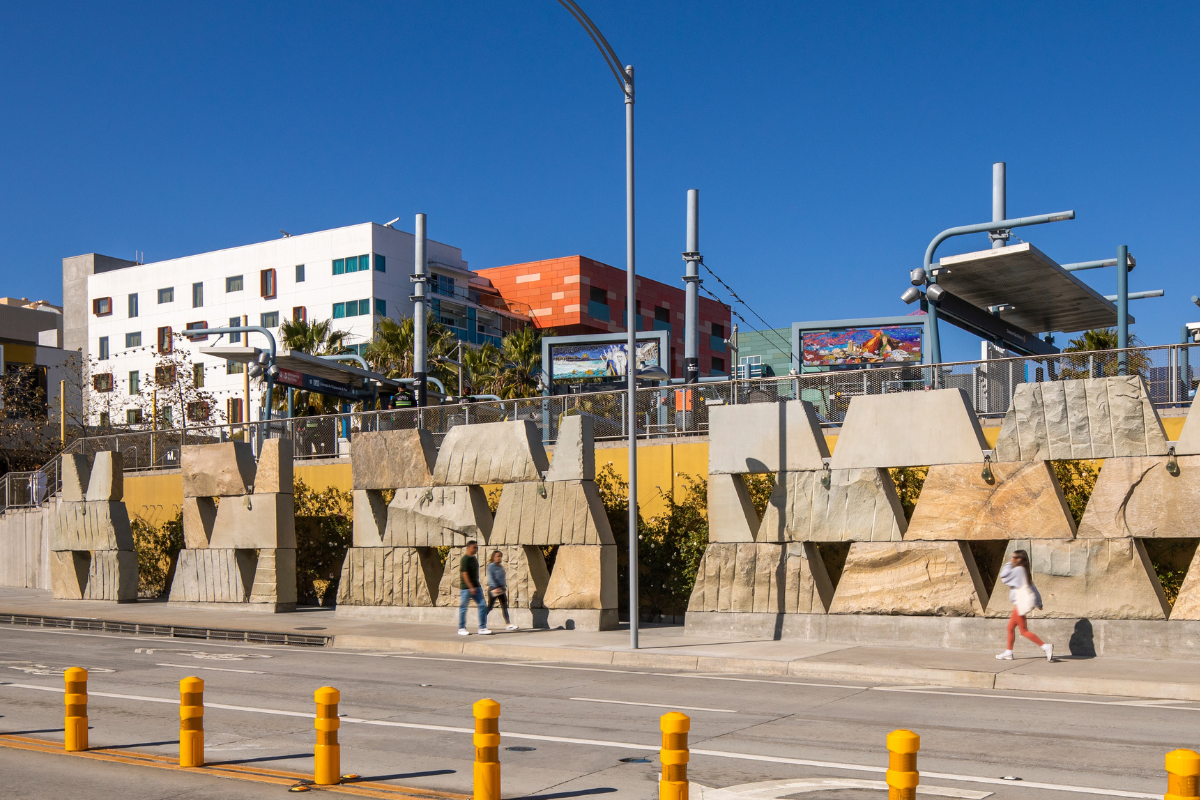
The sculpture’s monumental sandstone and hand-formed glass recall Kuruvungna, Saint Monica, the Crying Rock and the Palisades at the center of Downtown Santa Monica. Gold paint and climbing white roses adorn the station wall, glowing in the afternoon light, inviting pedestrians to weave through the sculpture and feel the awe of nature and heft of memory.

People read on trains to pass the time or, possibly, to avoid looking at others. Encountering images of people reading may trigger a reminder that reading might be a good idea.