
Passing Through
Each grouping of images within Union Station represent not only details from the physical environment, but also time and passage, light and vision, and the romantic notion of traveling and greetings over the years.
Each grouping of images within Union Station represent not only details from the physical environment, but also time and passage, light and vision, and the romantic notion of traveling and greetings over the years.

The artist’s use of a silk flower to mimic the imperfect appearance of a wilting lily—its blossoming, sagging, drying and falling petals—is a metaphor that investigates socially constructed notions of gender.

This artist team worked with project architects to form seating areas, planter walls and fountains which together form an inviting corner park.

Alison Saar’s Paraje is a reminder of the surrounding terrain’s natural history and is designed to offer transit users respite from the sun and wind. Located on the west end of the station platform and measuring 10 feet high by 10 feet wide, the cast stainless steel sculptural windscreen contains imagery inspired by the nearby Gardena Willows Wetlands Preserve, which is one of the few remaining pristine willow marshes in Los Angeles.

Union Station’s greenery is highlighted to create a temporarily refreshing moment and tranquil state of mind, recognizing that busy travelers may overlook the beauty of the station’s outdoor spaces and natural assets.

Artworks on gateway arches depict the legs of travelers headed to their destinations: a business professional with her rolling briefcase, a parent with a stroller and a hummingbird in flight.

Located just three and a half blocks from the Canoga-Owensmouth Historical Museum, the artwork conveys the urban and botanical history of the area.
Project Description John O’Brien designed terrazzo paving areas and porcelain enamel steel panels for station platforms. Artwork designs incorporate images taken from high altitude aerial photos and from landsat satellite sources. A person in transit can either enjoy the artwork from the purely decorative point of view or delve into its mapping and discover that it actually maps the area they are transiting through. Artist Statement “In my public art, I work to embed different levels of meaning into the final work in such a way all viewers can come away with some sense of its significance and beauty.” About the Artist JOHN O’BRIEN’S public art commissions in Los Angeles include the Mar Vista and Westwood Branch Libraries, Sepulveda Park West as well as the Los Angeles Riverfront Park. He has a Master of Fine Arts from the University of Southern California, and currently teaches as Assistant Professor in Sculpture at California State University Northridge. He has years of experience as an artist/educator and fabricator with a special focus on the traditions of assemblage art and …

Merge Conceptual Design, the artist team of Franka Diehnelt and Claudia Reisenberger was commissioned to develop color palettes and tile artworks for two stations along the El Monte busway.

Merge Conceptual Design, the artist team of Franka Diehnelt and Claudia Reisenberger was commissioned to develop color palettes and tile artworks for two stations along the El Monte busway.

Outward Bound depicts two young friends engaging with Los Angeles’s diverse cityscape on board the Metro.

“Out of Sight” by Merge Conceptual Design at Willow Street Station consists of a stunning glass canopy and concrete benches. The translucent glass panels are slanted to depict a photo image of a willow tree in the south direction, and a photo image of the web of catenary wires that power the rail system as seen from the north direction.

Flick presents the landscape of the major streets surrounding Expo Park/ USC Station as a stream of images one might encounter through the window of a moving vehicle.

This portrait of our metropolis offers a sense of both place and displacement, and underscores the need for a thriving public transportation system. The series also gives us a sense of where we are personally and on the level of urban planning.

The series depicts the rolling hills and native flora of western Los Angeles at Cheeseboro and Palo Comado Canyon and captures the foothill woodlands that run along the San Gabriel Mountains to the east through images taken at Descanso Gardens.
Jody Zellen designed terrazzo paving areas and porcelain enamel steel panels for station platforms. Artwork designs incorporate images from the San Fernando Valley that trace its architectural history and its relationship to the city of Los Angeles.
Bob Zoell has abstracted the appearance and arrangement of typographic design symbols to create a bold and graphic series of ceramic tile murals. The artwork covers four columns at station platforms at Wilshire/Vermont Station.
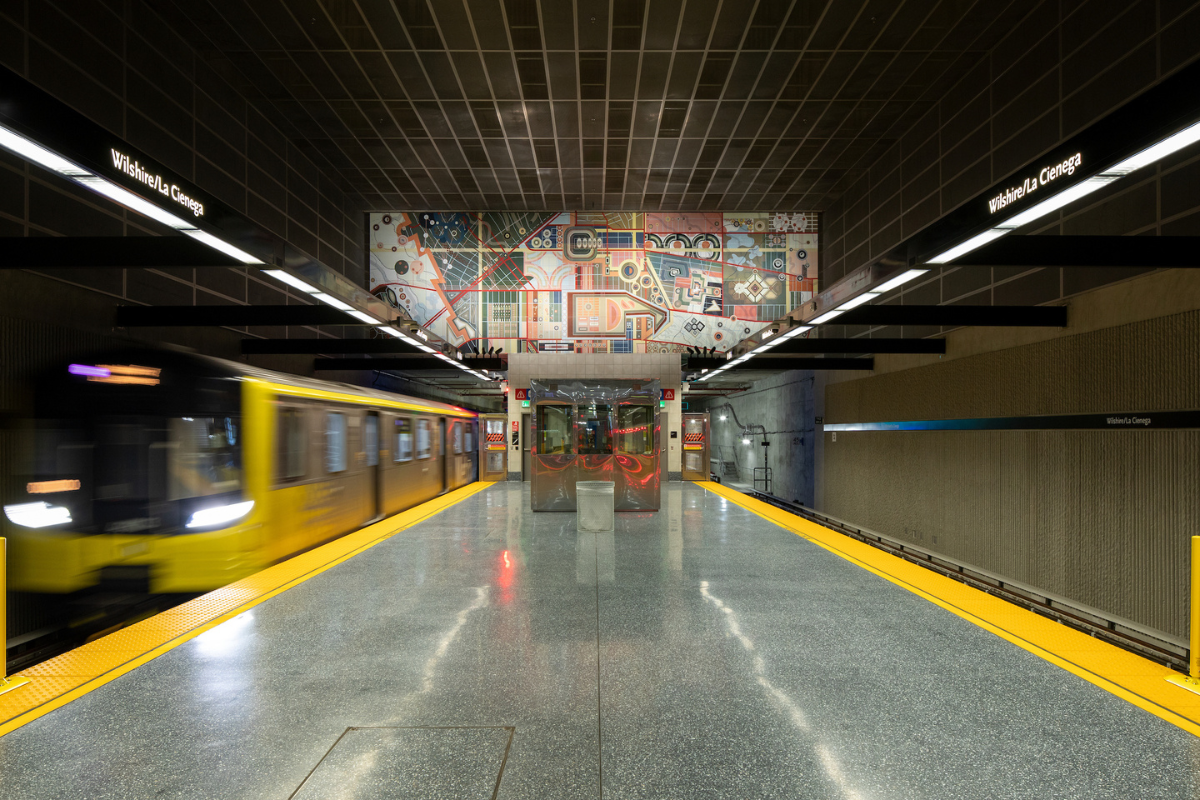
Soo Kim’s artwork concept for the station platform cuts and collages her photographs of the dense, urban topography along the Wilshire corridor with images she has captured throughout the world.

In 1924, the first neon sign in the United States was posted around the corner from Pershing Square. Commemorating this art form, neon artist Antonakos created Neons for Pershing Square, a series of neon sculptures suspended from the station’s high ceiling.

The final artwork–based on hundreds of photographs taken by the artist in the neighborhood–shares with Metro riders the gardens, front porches, living rooms and street life of area residents.

Titled Negative Space (STScI-2015-02), Mungo Thomson’s two murals for this subway platform evolved from a series of artworks in which he digitally inverts astronomical images from the Hubble Space Telescope’s online photographic archive.

John Humble’s compelling series of 12 color photographs, titled Natura Urbanus (2015), expands upon a long-term photographic project exploring the paradoxes and ironies of the Los Angeles landscape. Each set of three artworks considers nature in relation to one of four themes: the Los Angeles River, power lines, artificial nature and freeways.

The seven energetic images selected for this series were produced by a photogram process and tell stories that reflect the idea of journeys, passages, memories, and thresholds that define our lives.

Namonai ike in Japanese means, “a pond with no name.” Known for its picturesque beauty, this small village pond in the middle of Japan is neither named nor marked on a map.

Representing the first permanent art project for a Metro vehicle/bus, the seat fabric installed in the Articulated and 45’ Compo buses has been designed by Beep’Inc., the collaborative team of artist Pae White and architect Tom Marble.